From the Scoreboard to the Game Film
What John Finocchiaro and Ryan Magee shared on In The Shop about AI, training, and why dealers need more than the numbers.
Every dealership runs on a scoreboard. Units sold, PVR, product penetration, service RO counts. By the 5th of the month, you know exactly how you did.
What the scoreboard can't tell you is why.
Our CEO, John Finocchiaro, and Head of Growth, Ryan Magee, recently sat down with Shaun on In The Shop, the video series from The Shop powered by FordDirect. The conversation kept coming back to one question that drives everything we build: if not, why not?
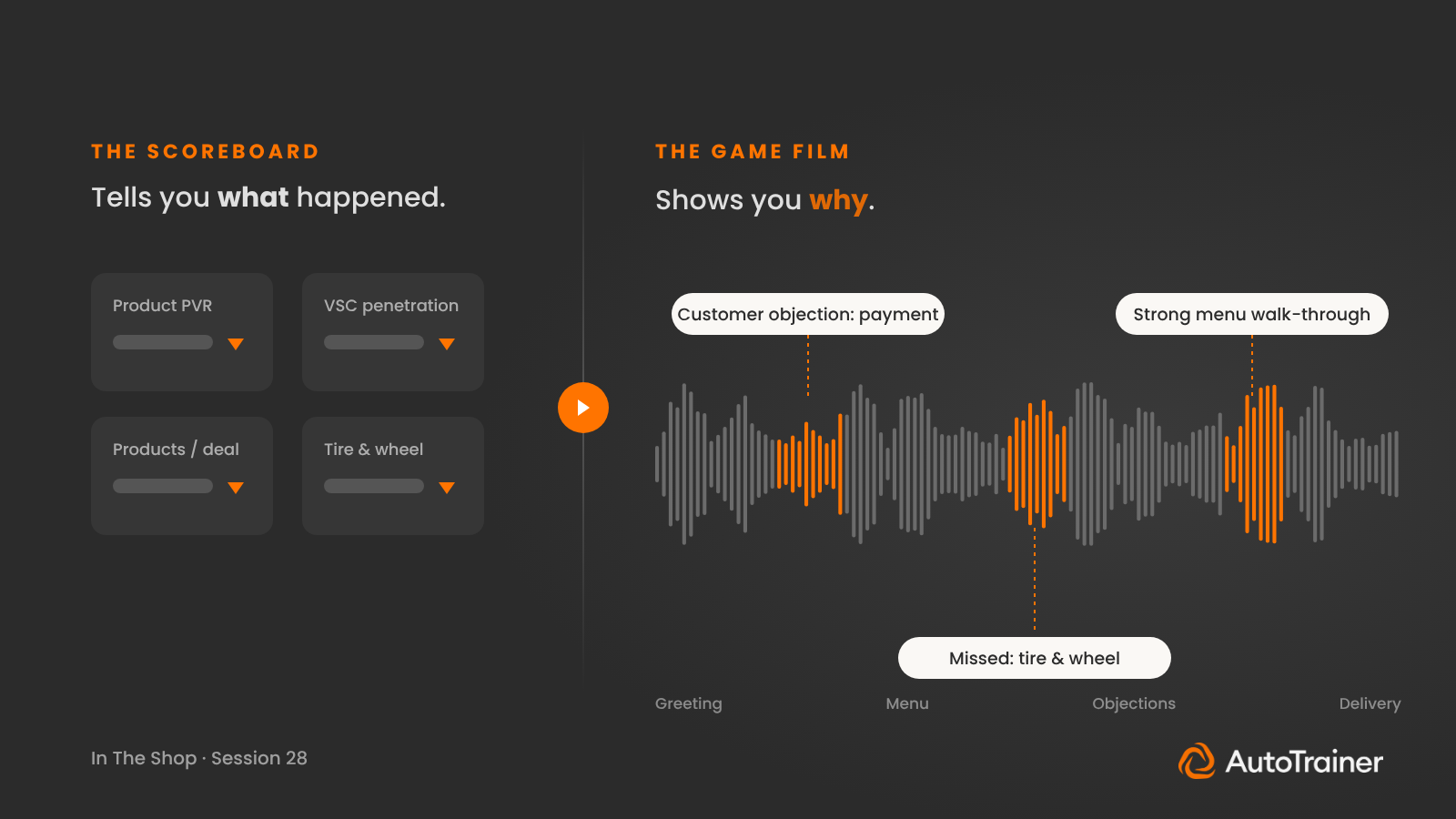
If your F&I office isn't hitting its numbers, what's actually happening in those conversations? For years, the honest answer was "nobody really knows." AI changes that. As John put it on the show: you've had the scoreboard for years, and now you can have the game film.
Here are five ideas from the episode that every dealer principal, GM and F&I director should be thinking about.
1. Most "training" is really exposure
John opened with a line borrowed from friends in special operations: "Nobody rises to the occasion. Everybody falls to the level of their training."
The problem is that most dealership training isn't training at all. It's exposure to best practices. A trainer shows the team what a great menu presentation looks like, everyone nods, and 90 days later most of the store is back to old habits. Every trainer knows that decay curve.
Real training looks more like sports. Ryan's favorite example is golf: watching a pro swing helps a little, but film of your swing, with someone showing you exactly why the ball goes left, is what actually changes your game. John trains Brazilian jiu-jitsu, and he says the same thing. He doesn't get better when the coach demonstrates a move. He gets better when he drills it, over and over, in a way that fits him.
That means training has to be repeated and personalized to each person's real strengths and gaps. Until recently, nobody could do that at scale. Now AI can.
2. Stop practicing on real customers
This industry spends too much time trying new techniques on live customers, with real money on the line. AI role-play gives your team somewhere else to practice.
Ryan explained it this way: traditional role-play needs two people, one of whom has to play the customer. That person is usually too easy or too hard on their colleague, and finding the time is a challenge. An AI customer is available anytime, on any topic, and it pushes back exactly as hard as you want it to. Because it learned from real consumer conversations, it reacts the way real customers do.
One example from the episode: a service advisor knew a customer was coming in that afternoon who needed a transmission. His manager built a role-play around that exact vehicle, the repair cost, and the option of trading into something new. The advisor ran it once, walked into the real conversation feeling ready, and sold the repair.
Some of our partners now have their teams do a quick role-play before they ever pick up the phone in the morning. Most of our role-plays take about six minutes. We're not asking anyone to take on a second job.
3. Spot-checking chases ghosts
There are two ways most managers spot-check. Either they pull a deal because the numbers looked unusually good or bad, or they sit in the box during a delivery. Neither shows the whole picture. Any deal can be an outlier: a bad day, or a customer who was never going to buy. And everyone is on their best behavior when the manager is in the room.
Then there's recency bias. Ask an F&I manager what's holding them back, and they'll describe their last rough delivery. That's rarely the real pattern. John called it chasing ghosts.
AI that coaches you on every single conversation, one at a time, doesn't fix this either. It turns into what John called "mental whack-a-mole": a different correction after every deal.
The better approach is to look at everything a person did that month and find the few behaviors that matter most. As Ryan put it, the more conversations we see, the better we can coach, because we're coaching the trend, not the last deal. Our job is to skip the haystack search and just show you the needles.
4. Ask what should have happened
Most dealership data is descriptive: it tells you what happened. AutoTrainer is built to be prescriptive. It shows what happened, what should have happened, and what will close the gap.
In F&I, that sounds like this: this many service contracts should have sold and didn't, this many tire-and-wheel packages too. Here are the conversations that show why, down to the individual manager. Here is the role-play that fixes it. When a recommendation comes with three or four of your own calls attached, you don't have to argue for buy-in. The person can hear it for themselves.
That's the moment leaders sit up in their chairs. When we analyze a multi-store group, we can often show seven figures in missed F&I product sales over 60 days, along with when it happened and why.
In finance, partners typically see:
- $300 to $500 lift in product PVR after the first 90 days
- 25 to 35% more products per deal
- Faster onboarding: one group cut its new-hire program from four weeks to three, and those hires started selling sooner
The same lens works on process, too. Is your playbook actually working? Who's following it, who's straying, and who's doing something brilliant that the whole team should copy? Ryan said that used to take someone watching the floor full-time. Now it shows up in the monthly review.
5. Roll it out with curiosity, and vet the AI
AI will show you things about your team and your process that you've never been able to see. Some of it will surprise you. How you handle that matters as much as the technology.
John's advice: make it more carrot than stick. It's new information for your team and for you, so learn from it together. Going from flying without instruments to flying with them is a big change, and nobody should be expected to perform like they've had it for years after a couple of months. As John put it, "All accountability is, is dealing with reality." Any news that answers "if not, why not?" is good news.
Ryan added that automotive is still a people business. Customers want a person across the desk, and AI can't replace that. What it can do is make that person better, and give leaders a Moneyball view of their stores: metrics that help them hire, staff and coach better than old-school reports ever could.
Last, vet your vendor. AI will always give you an answer, but it never says "I don't know." Before you build plans around anyone's AI insights, ask:
- What is it trained on?
- How long has it been working in automotive?
- How many real dealership conversations has it learned from?
- Can your leaders trust it enough to coach their people on it?
AutoTrainer has spent more than four years learning from hundreds of thousands of dealership transactions. It has only ever been built for automotive.
Watch the full conversation
The full episode covers much more, including the moment Shaun compared AI for dealers to looking in a mirror for the first time. Watch Session 28 of In The Shop on YouTube.
AutoTrainer is a preferred vendor of The Shop powered by FordDirect. If you're a Ford Dealer or Lincoln Retailer, you can access AutoTrainer through The Shop. Book a demo to see what your own game film looks like and where your team can sell more products.